
Trace Bolivar County Previous Owners
No single assessor summary can list every prior owner. The real answer sits in a chain of recorded transfers. Pull the current parcel card and the latest deed first. From there, note the grantor on that deed. Then search for the same party as grantee in an earlier book. Repeat that step as far as the index allows. When the online records stop, the trail continues in courthouse volumes. It also runs through library microfilm and MDAH holdings.
| Source | Years It Covers | Where Held | What It Shows |
|---|---|---|---|
| DCS deed index | Start year not published | Online; official index at courthouse | Grantor/grantee, date, instrument and book/page |
| Library deed microfilm | 1836-1903 documented runs | Bolivar County Library Mississippi Room | Earlier recorded deeds and book sequence |
| MDAH tax rolls | 1836-1918 catalog coverage | Digital archive, catalog and microfilm | A second year-by-year ownership clue |
| County record finding aid | 1836-1978 | MDAH Series 2050 | Original-record and archival request leads |
The online index never states an earliest year. Treat its reach as unknown. The physical and microfilm record reaches back to 1836. But you cannot assume the digital version follows. For recent former owners, the district index is the place to start. Nineteenth-century chains begin instead with known book and page references. The courthouse and the library or archive catalog also anchor those searches.
Start With the Latest Grantee
The current parcel card holds the key facts. It lists the OWNER, parcel number, PPIN, legal description, and often a deed book and page reference. Use that reference to pull the acquiring deed. The grantee on it received the interest; the grantor conveyed it. That grantor becomes your next name to chase backward.
Names alone can mislead. Families reuse names, and entities change form over the years. So carry the subdivision, block, lot, Section/Township/Range, book and page, and instrument number through every step of the chain. A consistent legal description keeps you on one tract even when the street label or tax parcel number shifts.
Note: A sale-history row is only a lead, never a full deed chain or proof of every interest.
Bolivar's Two Deed Districts
Bolivar County splits its deed records between two judicial districts. Past owners can vanish if you search only one. The Chancery Clerk runs a Cleveland index and a separate Rosedale index. Each search accepts grantor, grantee, book and page, filing date, survey-grid, subdivision, and instrument clues. Check both.
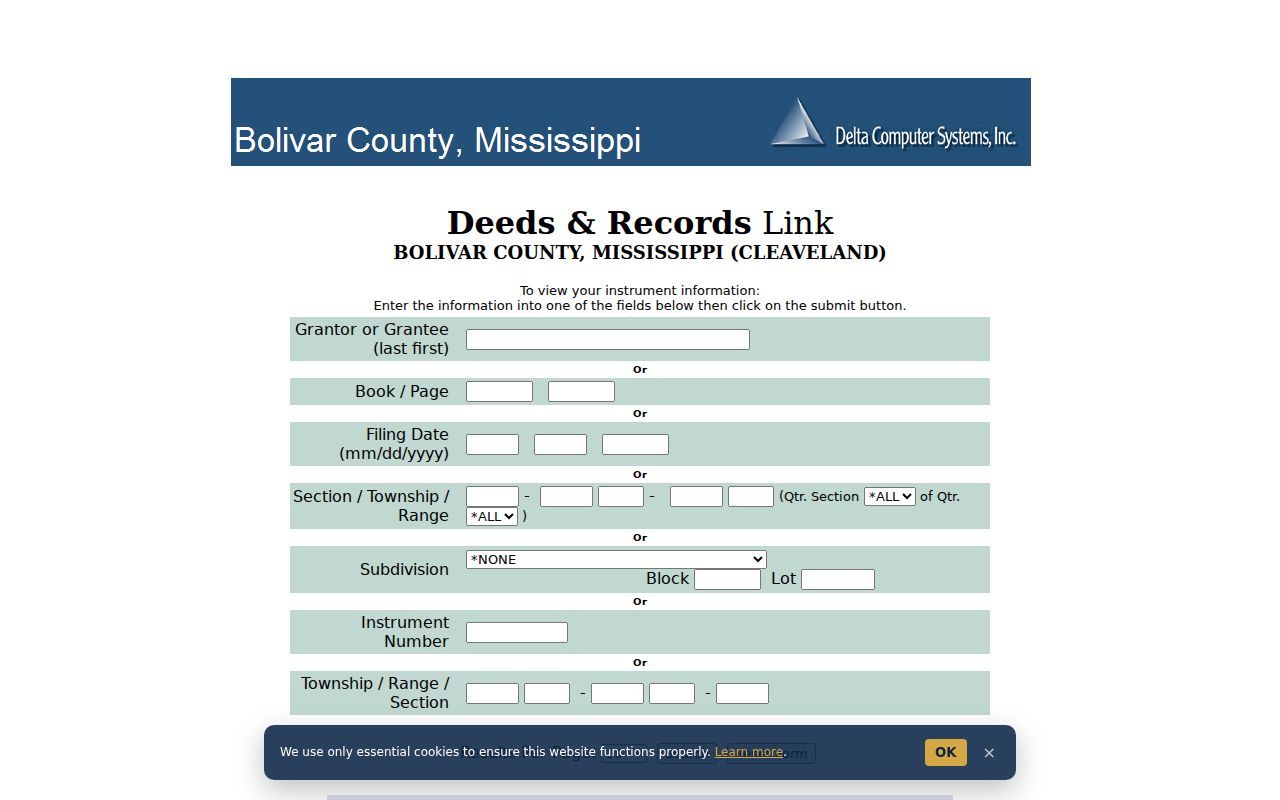
The Rosedale district presents the corresponding search route for First District land.
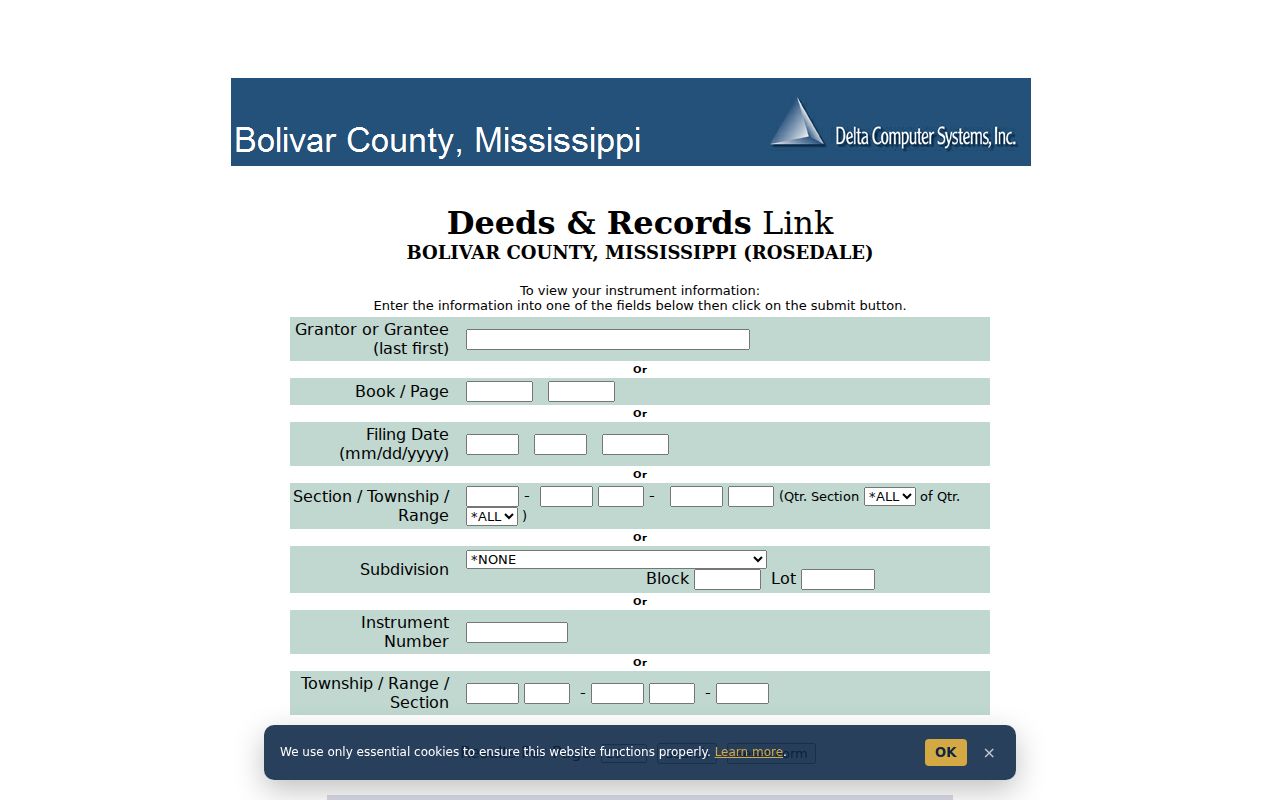
Run a search in each district. That step is basic to rebuilding a Bolivar County chain of title. The same deed may sit in either index. The Cleveland form pairs its grantor and grantee fields. It adds a land-description box on the official deed records page.
The web index itself is not the official record. The courthouse holds the authoritative Land Records Index. Updates land at noon, 3 p.m., and after close on business days.
Pricing runs $0.50 per page, $30 monthly, or $330 annually. The land records room stays open for in-person review Monday through Friday. Hours run 8 a.m. to 5 p.m.
Reconstruct Bolivar's Chain Backward
Rebuilding a Bolivar County ownership chain works best as a tight loop. Work backward deed by deed. Every deed must tie the right grantor and grantee to the same parcel of land. Each pass should capture the date, parties, deed type, and book and page. When a link goes missing, treat the gap as something to investigate. Do not guess at an owner of record.
- Find the current owner as grantee on the newest deed and verify the legal description.
- Enter the named grantor as a grantee in the prior date range.
- Repeat while recording each transfer date, deed type, and book/page citation.
- When the online record ends, continue through the official index, deed books, and microfilm.
- Grantor
- The party conveying the stated property interest.
- Grantee
- The party receiving that interest.
- Chain of title
- The ordered run of instruments that transferred interests in the same land.
- Reverse index
- An index arranged to help find parties in the opposite grantor or grantee role.
- Quitclaim deed
- A transfer of whatever interest the grantor has, without the warranties of a warranty deed.
Bolivar Deed Books Begin in 1836
Bolivar County dates to 1836, and its earliest deed books survive from that era. A library finding aid maps the holdings: Volumes 1 through 3 cover 1836 to 1891. Volumes 4 through 6 cover 1891 to 1903. Lettered books fill parts of 1836 through 1875. Transcribed entries from 1836 already describe land by Section, Township, and Range. That survey language makes parcel matching easier.
The Bolivar County Library Mississippi Room supports this work with a microfilm reader. It also holds deed and tax sources, newspapers, and vertical files. A transcription can point you to a likely deed. Still, inspect the film or the original before drawing any conclusion about title.
Tax Rolls Test the Owner Sequence
MDAH Series 1202 groups digitized tax items for Bolivar County's earliest years. The catalog extends the county's tax rolls through 1918. Tax rolls are not deeds. Instead, they offer a second ownership trail. That trail can flag the year a name first appears or drops away against land when deed clues run thin.
The MDAH digital tax-roll series supplies item-level images for the years it lists. Match each tax name against the deed chain and the legal description. An entry can reflect an assessment quirk, an estate in transition, or a recording lag. That is why a Bolivar County tax roll should corroborate the property records. It should not replace the transfer record itself.
Probate Can Break a Straight Chain
Death can bend a straight deed chain into something crooked. Estates bring wills, court orders, executor deeds, administrator deeds, trusts, and life estates. Bolivar County's Chancery Clerk keeps the probate and estate files. State death records stay restricted. Yet a qualified requester may use them to pin down an heir or a transfer fact. They still convey no land on their own.
Search the decedent, the estate, the executor, the trustee, and every named grantee. Give ETAL, ET UX, estate, trustee, and LIFE ESTATE their own lines in the notes. The LIFE ESTATE legal line on a sample assessor card shows the payoff. A current parcel record can point straight back to the instrument. That instrument is the one that split the ownership rights in Bolivar County property records.
Plats Preserve Former Parcel Names
Bolivar County's deed forms accept subdivision, block, lot, and survey-grid searches. The local vocabulary includes revised plats, Cleveland Original Town, and Shelby Annex. It also covers West Rosedale and not-platted entries. A prior owner may hide under an old tract label. The modern property record may carry only a street and parcel number.
Read the plat as a map of the recorded lot layout. Then chase book and page references into the deed records. Revised plats, splits, and combinations can shift parcel identifiers. They do not erase the older chain of title. Through every change, the legal description stays the stable bridge. It anchors any Bolivar County property search.
Note: Try historic subdivision variants when a modern street fails. A parcel number may also fail to surface a prior transfer.
Newspapers Add Bolivar House History
Bolivar County's library keeps Bolivar Commercial and Cleveland Enterprise microfilm. Staff can run obituary searches when a month and year are known. The Library of Congress lists The Bolivar County Democrat of Rosedale, 1887-1969, with digitized issues in Chronicling America. Notices add color around probate, foreclosure, tax sale, subdivision announcements, and estate sales.
Remember what newspapers are. They identify events and occupants, not title. Treat them as leads back to the deed book, the probate file, or the tax roll. Delta State's manuscript collections and the WPA county files supply local texture on plantations, floods, railroads, and civic life. None of it substitutes for the land record itself in Bolivar County property records.
How Deep Bolivar Ownership Goes
Deed books for Bolivar County reach back to 1836, the county's founding era. Online property records have no firm start year, though. For older parcels, work outward from the courthouse official index and the deed books themselves. Bolivar County Library microfilm comes next. MDAH digital and microfilm holdings follow, then archival finding aids. FamilySearch catalog leads may surface additional films. But image restrictions and exact contents must be checked case by case.
The MDAH Bolivar finding aid points to original county material. It includes land records and tax-collector sales. A clean ownership chain may still need professional title work. Probate, trusts, life estates, missing images, or conflicting parcel descriptions can all break the series.
Lawful use. Trace previous owners for house history, estate work, or property diligence. Never use these records to stalk, target, or harass anyone.